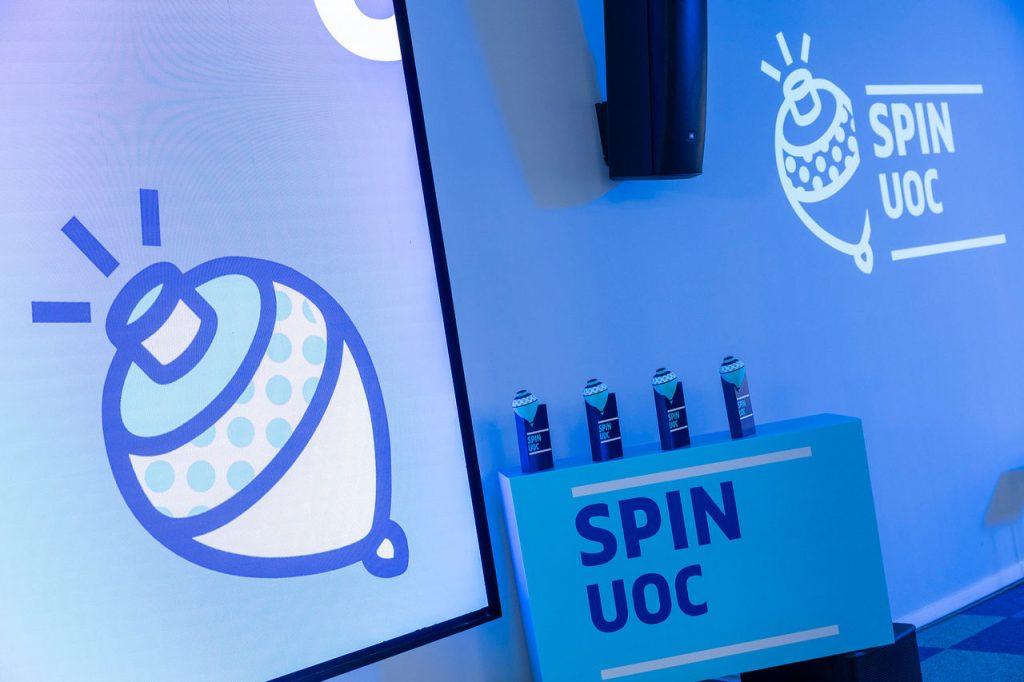
Barcelona, 19 November 2026. The UOC Rural Network and the Odisseu project have announced the four winning projects of the 2025–2026 UOC Rural Awards. The initiative recognises how university knowledge helps to analyse and respond to the challenges facing contemporary ruralities.
The UOC’s UOC Rural Network has launched a new edition of the UOC Rural Awards together with the Consorci GAL Alt Urgell-Cerdanya, as part of the Odisseu project. The awards go to the best 2025/2026 bachelor’s degree final projects (TFG) and university master’s degree final projects (TFM) linked to the challenges of contemporary ruralities. More than 70 projects were submitted. The figure shows how keen students are to tackle the social, economic, cultural and environmental challenges of rural areas across a range of disciplines and fields of knowledge. This edition gave four awards, two for bachelor’s degree final projects and two for master’s degree final projects, each worth €1,000.
The UOC Rural Awards aim to recognise and raise the profile of university talent that helps to understand and transform rural realities. They also highlight final projects as a meeting point between academic learning, applied research, and the needs and opportunities of local areas. The initiative starts from the view that ruralities are diverse, dynamic spaces with a capacity for innovation, where university knowledge can help drive new responses to today’s challenges.
This year’s edition strengthens the focus on territorial connection through the UOC’s collaboration with the Consorci GAL Alt Urgell-Cerdanya, within the framework of the Odisseu project. The partnership deepens the ties between the university and local stakeholders. It also helps knowledge produced in academia to engage with the priorities and needs of rural communities.
The Odisseu project has a long track record of promoting university work placements in rural areas and final projects connected to them. Mireia Font Gras, manager of the Consorci, says that “collaboration between universities and the rural community helps to connect knowledge with these realities and contributes to the dynamism of our rural world.”
“The projects submitted show that contemporary ruralities are an area of growing interest for students, and that, across very diverse disciplines, the university can help to generate knowledge and innovative proposals in response to the challenges facing rural areas. Working with the LEADER groups allows us to strengthen this connection between the university and the territory, and to move towards a knowledge transfer that is closer to the needs and opportunities of rural communities,” says Soledad Morales Pérez, academic coordinator of the UOC Rural Network.
Design and implementation of a fuzzy-logic-based multi-agent system for controlling a smart irrigation system | Bachelor’s Degree in Computer Engineering | Barcelona
Damià Lluch Vila won the Odisseu Award for the best TFG for designing a smart irrigation system (IMAS) that optimises water use on farms as the climate changes. His proposal uses the Internet of Things (IoT) and fuzzy logic, through collaborative autonomous agents, to match irrigation to what the crop actually needs and so avoid wasting a scarce resource. The system has a modular, sustainable and scalable architecture that reduces farmers’ manual workload and adapts easily to plots of different sizes. The solution is designed as a key support tool to improve efficiency, quality of life in rural areas and environmental sustainability, without replacing human judgement.
Discursive hegemonies in the energy transition: a critical analysis of Sino-Brazilian cooperation and its impacts on Amazonian Indigenous communities (original title: “Hegemonías discursivas en la transición energética: Un análisis crítico de la cooperación sino-brasileña y sus impactos sobre las comunidades indígenas amazónicas”) | Bachelor’s Degree in International Relations | València
Guillermo Llorens Castaño won the Award for the best TFG for a study of cooperation between China and Brazil. He concludes that the official discourse of the energy transition legitimises hydroelectric megaprojects in the Amazon that violate the rights of Indigenous peoples. The research shows how these infrastructures, presented as unquestionable green solutions, cause forced displacement, loss of land and violence against local communities. It also reveals that the rhetoric of South–South cooperation hides power imbalances and reproduces colonial patterns of territorial exploitation. In the process, ancestral knowledge and Indigenous worldviews, which advocate autonomous energy models that respect nature, are rendered invisible.
Towards socially responsible data centres: governance, impact and territorial return. The case of the Móra la Nova AI gigafactory | University Master’s Degree in Innovation and Digital Transformation | Esplugues de Llobregat
Lluís Sergi Sarri Camargo won the Odisseu Award for the best TFM for a project that proposes a Territorial Return Index (TRI). The index aims to ensure that large artificial intelligence data centres have a positive, measurable and enforceable impact on rural areas. Using the planned AI gigafactory in Móra la Nova as a case study, the research gives municipalities a tool to assess and negotiate the siting of this kind of critical infrastructure. The index combines environmental, socio-economic and governance indicators so that these projects do not simply extract water and energy resources. The study concludes that, for the gigafactory to drive a genuine digital transformation in the Ribera d’Ebre, transparent governance, audits and verifiable public data will be needed to guarantee job creation and local talent.
The ecosocial transition as a process of redefining and evaluating satisfiers | University Master’s Degree in Philosophy for Contemporary Challenges | Sant Hilari Sacalm
Cristina Fernández Jiménez won the Award for the best TFM for a project that proposes an ethical-ecosocial framework and practical tools. These help communities meet human needs while respecting the planet’s ecological limits. The research focuses on transforming “satisfiers”, the specific means by which those needs are met. It offers a constructive, community-based alternative to models built on unlimited consumption. An evaluation matrix and a deliberative graphic tool make collective decision-making easier. The methodology can be transferred to rural settings and promotes social innovation and shared governance to build fairer, more sustainable and more resilient ways of living.
More information about the Odisseu project: https://www.odisseujove.cat/premis-odisseu-uoc-rural/